
J. Cole: The Fall Off Review (Test)
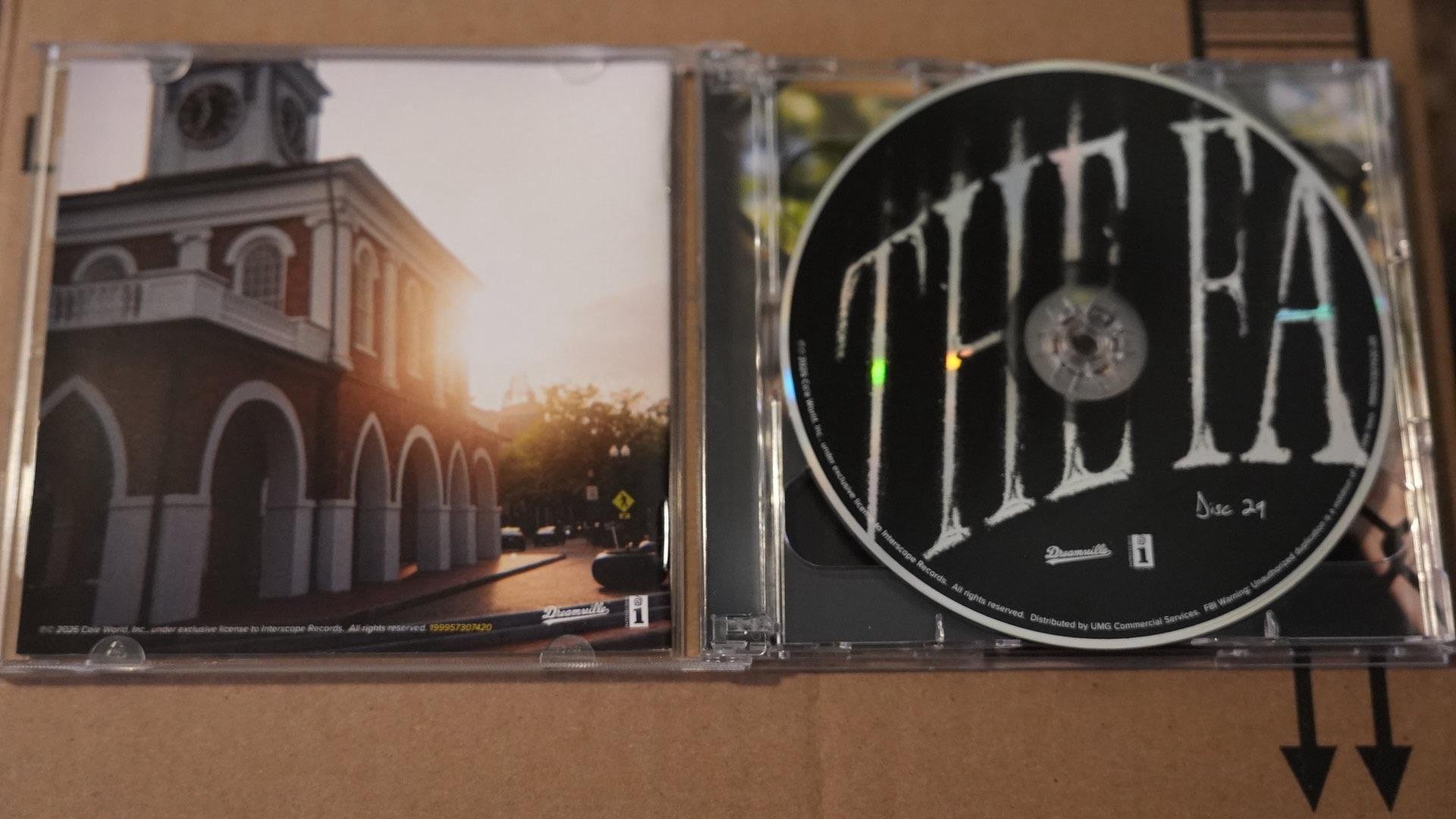
Favorite songs: Safety, Run a Train, Lonely at the Top, Legacy, The Villest
Disclaimer: Throughout the review, I refer to Kendrick Lamar as Dot and Drake as Aubrey. XM is not interested in racing the algorithm. We live with the music before publishing an opinion, because art deserves more than an immediate reaction.
I – Intro: expectations + stakes
Greatness in rap has always required risk. Not just technical excellence, but the willingness to rupture something – reputation, alliances, self-image. J. Cole has spent the better part of his career proving he possesses the skill required for greatness. What The Fall Off ultimately reveals is an artist still reluctant to pay the cost.
By framing this as his final album, it’s impossible not to consider where Cole stands among his contemporaries. Cole coined the term “the big three,” referring to himself, Kendrick, and Drake, defining his competitive universe, but when that universe collapsed into open conflict, he chose withdrawal. That decision reframed this claim – not as confidence, but as positioning, causing many to question his place in the pantheon of rap gods.
This is a long-awaited album that sought to be a cultural moment but fell flat. If the marketing department did get one thing right, it’s that this is the definitive Cole album. In fact, it’s the Cole album, and it couldn’t be a more Cole album if it tried. Every trope you expect from him is here in full force; it’s just rapped better. It’s a very middle-of-the-road record, where internal rhyme schemes are deft and sharp, none of the rapping is lazy or phoned in, but it struggles to elevate itself beyond rap nerdery due to stunted creative decisions.
II – Musicality
The internet eradicated regionalism, but it’s steadily making a comeback. Kendrick locked into a Cali-sound with GNX, and Drake has been curating the Toronto sound since he tried to trap Abel in the OVO basement. This was the time to do something daring, but what we got is another New York-leaning album circa 95-03.
Cole has always gravitated towards a jazzy boom-bap sound, but it’s not unfair to expect evolution if you’re claiming GOAT status and your peers continually innovate their sound. On Old Dog, he calls in Carolina veteran Petey Pablo for an homage to Raise Up and slaps a lil Southern bounce on the back end of WHO TF IZ U, but it’s as much as we get.
Early-career Cole sought to be the biggest super-producer-rapper hybrid since Kanye, but missed that, for each album, Ye brought in a guide. Late Registration had Jon Brion. Graduation had DJ Toomp. 808s had Mr. Hudson. Dark Twisted Fantasy had everybody and their momma. Cole's Achilles heel is still his tendency to do everything himself, not realizing that his peers’ transcendence lies in their openness to collaboration.
Run a Train and Bunce Road Blues use Future features to middling effect. When I think about Dot keeping the absurdity of “la-di-da-di-da” on “King’s Dead,” for better or worse, that’s curation that utilizes an artist’s idiosyncrasies. Cole uses Future’s rasp to convey frustration, but instead of giving him room to breathe, on "Train" we get a Cole-drafted melody that makes Future sound like an impression of himself.
Throughout listening, I couldn’t help but think Dot has recently had major wins with Not Like Us and Luther, and Drake is Drake, so Cole – wtf are you doing, not swinging big for the hit single?
Cole has two Diamond singles as a lead artist (No Role Modelz, Middle Child), and one on the cusp of certification (Wet Dreamz). The Black Album spawned Dirt Off Your Shoulder and 99 Problems, two of Jay-Z’s biggest hits, and he sought them with intention. We don’t care that he tapped into his network of super producers; we only remember how the music made us feel. Cole is capable of making records that transcend his core audience.
If there were ever a time to imprint on the collective conscience you’re that nigga, it would’ve been now.
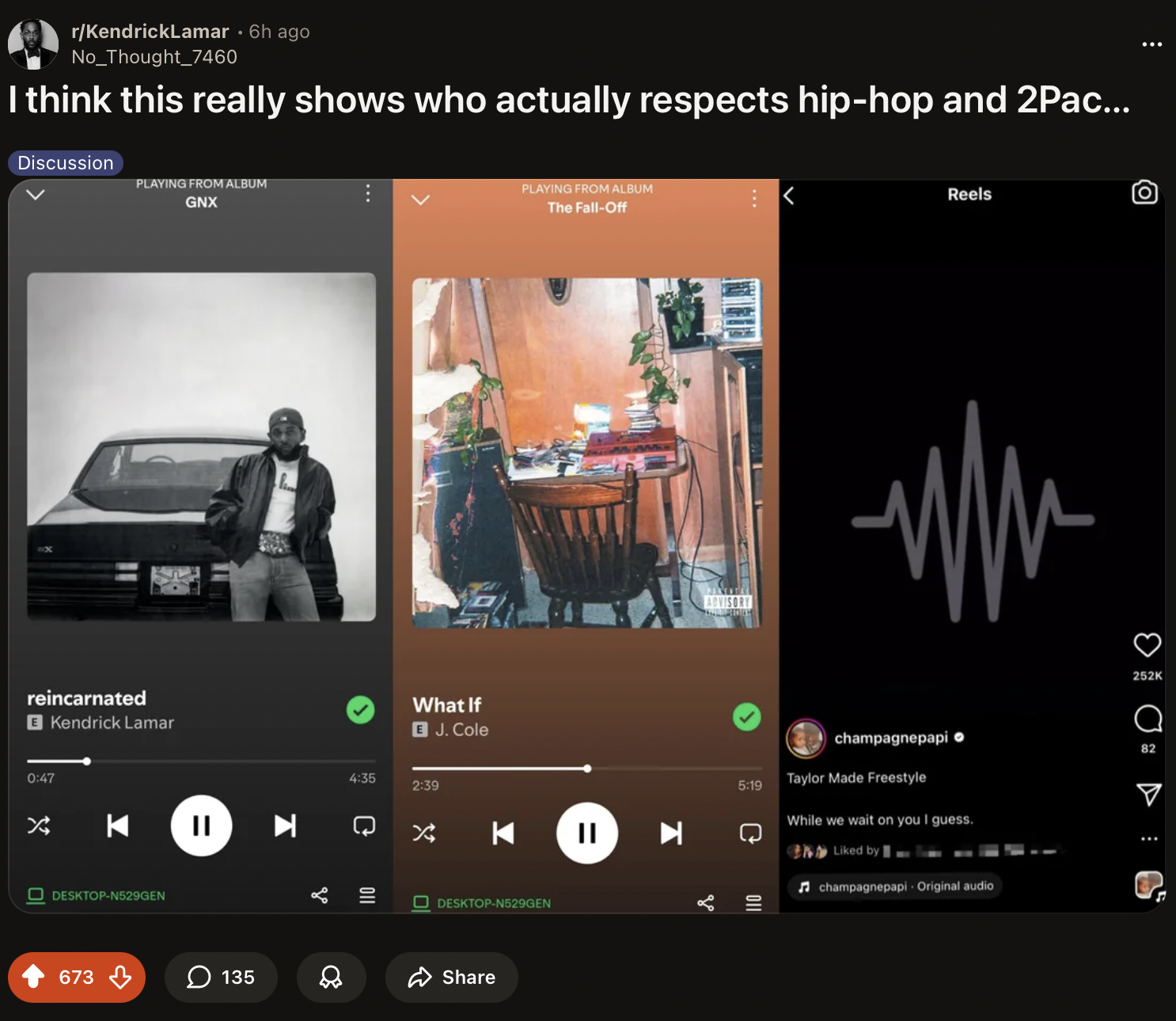
Screenshot from Reddit comparing each of the Big Three’s use of 2Pac in their music
III – Beef, The Big Three, Legacy
“Rappers rap about other rappers all the time — subliminal insult, direct attack — but rarely from a place of love. "That speaks to the state of us as a people," he said. "For so long my mind state was, I have to show how much better than the next man I am through these bars. Who's the best? Let me prove it. And it's just like, damn, I'm really feeding into a cycle of keeping black people down, I'm really feeding into that.” – J Cole
Cole once framed rap competition as a destructive cycle rather than a noble one, yet in 2018, he embraced the competitive posture he once criticized, embarking on a run that positioned him as rap’s “feature king,” out-barring everyone on their own records.
After Dot became rap-game Thanos, he, Cole, and Aubrey have now clashed at the apex of their trajectories. In a long, dragged-out, messy dispute between frenemies, Cole – self-dubbed the middle child – scrambled to pick a side and found himself Stretch Armstrong-ed, trying to hold onto both parties, tied in knots by his own tongue.
What If – a concept record where BIG and Pac apologize to each other instead of being murdered – is being interpreted as an olive branch to Kendrick, but lines like “what if the bullshit never got in the way, I’ll still have my nigga till this day” feel less like reconciliation and more like revisionism.
The timeline is public. 7 Minute Drill dropped April 5th 2024. Drake’s Push Ups arrived April 19th. Cole shot first. The narrative isn’t ambiguous, yet on 39 Intro, Cole raps, “they tried to put my neck inside of a noose, it’s not happening” – yes, and you handed them the rope. Man might have even braided it himself.
A fan-created version of the song with Pac and BIG AI voice filters highlights the two-dimensionality of Cole’s writing: “And maybe that’s what provoked you to use your vocals to speak my name with a negative tone” – his penchant for telling and not showing compromises his ability to humanize, reducing people to narrative devices rather than fleshed-out characters.
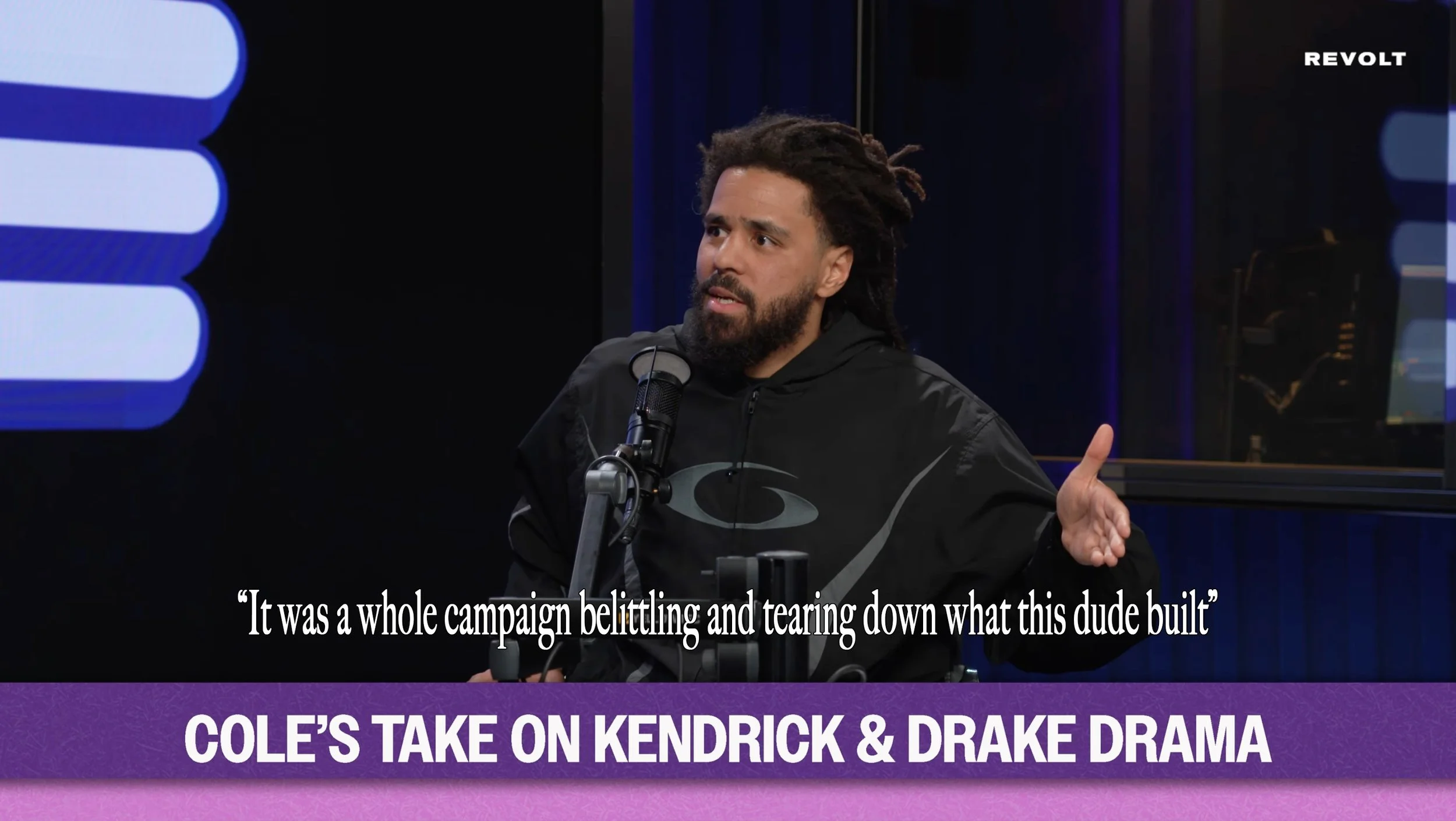
J. Cole on ‘Talk With Flee’ with Cam’ron, asserting that cultural critique of Drake’s art has an agenda behind it.
Not Like Us puts Aubrey in the scope, but equally addresses a culture-wide epidemic of infiltrators who exploit the culture for validation to further their personal agenda. Paulo Freire calls this cultural invasion, in which participants outside the culture seek to dominate by imposing change on those within it. Hip-hop is built on a code of ethics, and one of those is authenticity – but two of the big three have tried leveraging their star power by riling up their stans to rewrite the culture so that fake becomes the new norm.
If you care about being the GOAT, participating in Third-Person Shooter shits on the value of that. If Drake claims to be "one away from Michael", does it stand if the hits were not penned by him? Cole’s dedication to Hip-Hop classicism exposes his feigned ignorance of what it takes to earn GOAT status, which is why his bars aimed at imaginary rappers fit Drake to a tee.
The concept of “the big three” invalidates everything that gives credence to Cole’s artistry because, evidently, being an emcee really fucking matters to him. Cole avoids reconciling this, so he never directly addresses the conundrum; instead, the bars on Golden Goose Freestyle aimed at imaginary rappers fit Drake to a tee.
Protégé?
Jay-Z gets a lot of hate these days, but we forget he’s been the prototype for longevity since tying The Beatles’ record for number-one albums on the Billboard Hot 100. These accolades were never a focal point until Jigga took shots of D’usse from his hoardes of Grammys, simultaneously flexing and shoulder shrugging white institutional validation of black art. All of the big three have picked up game from Jay, but despite being his former signee, Cole seems to have learned the least from him.
On Bombs in the Ville, Cole speaks to his younger self and tries to reconcile with him that the life he’s built for himself is far beyond failure, but would a GOAT really write a verse like that? Jay rapped this only three songs into his “retirement album”:
But real shit when you bust down my lines
Add that to the fact I went plat’ a bunch of times
Times that by my influence on pop culture
I’m supposed to be number one on everybody list
We’ll see what happens when I no longer exist
Fuck this, man…
Mic drop, then let the beat speak:
“WHAT MORE CAN I SAY!”
My resume says EVERYTHING.
I’m certified.
A one-of-one.
Influence undeniable.
Cole can definitely flex in this department. A star of the blog era, he’s accumulated a streak of seven number-one albums since his debut, which sold 218K in its first week. He used college tours to contextualize his fanbase as his peers, inspiring millions, including me, to chase their dreams. Diamond singles, going “platinum with no features”, an insane feature run – however, critiquing Kendrick’s catalog in response to the Like That verse, exposed a lack of central argument around his own discography.
It’s clear that Cole’s brand of humility collapses under competition. The moment he is required to defend his self-proclaimed greatness, the moral posture that made him admirable becomes a constraint, and this restraint now appears less like virtue and more like brand maintenance. When Cole apologized for his diss, it reframed his competitive mythology. It suggested that the persona of the quiet assassin was never meant to survive real confrontation.
IV – Subject matters: why it feels hollow
If the younger Cole on Bombs needs reassurance that his decision-making won’t amount to nothing, what experiences bridged the psychological gap between him and present-day Cole? After several Dreamville festivals, marriage, two children, finding common ground with Jay-Z after starting his own label, going to hoop in Rwanda – there’s so much to explore, and yet he doesn’t. It makes the constant rapping about violence in the Ville exploitative. He siphons authenticity by approximation to struggle, while simultaneously confessing that he’s too busy flying on private jets to do anything about it.
Kendrick boasted before God that he “put 100 hoods on one stage,” scoring gang member become rapper Left Gunplay a Grammy after an alley-oop on GNX, bridging black and brown communities in LA. Culture vulture or not, the Drizzy stimulus package has breached international acts into the zeitgeist, when staunch patriotism flared its nostrils at anything that’s not an American accent. Meanwhile, Cole left hometown talent scrambling to put together a cypher to capitalise on the media attention this album was generating.
Comparatively, GNX sounds more like a curtain call than The Fall Off. It’s a brisk 12 tracks that tackle the beef, a victory lap after burying “opps and allies”, calls for a city-wide block party, clarifies why we didn’t get a Black Hippy project, and closes with a romantic tale that all this shit happened for the love of the craft.
For how much Cole claims he’s the greatest, dropping his swan song a week before Dot became the most Grammy Award-winning rap artist of all time, surpassing Jay, after sampling that clip at the beginning of Rise and Shine on his debut, is unfortunate timing.
Cole remains unsure whether he’s a lion or a lamb. Competitor or peer. Warrior in the garden or just a gardener.
V – Legacy
Part of accepting this record is grieving the fantasies we had about what was being cooked up behind the scenes.
The Fall Off was framed as the culmination of everything Cole had learned over his career, sharpening his skill set through discipline so he could capture lightning in a bottle when the time was right. Instead, chases tropes he thinks are the ingredients of a classic, not understanding that truly transcendent records require artists to transcend themselves.
It's sad because blog-era classics don't fall into the same remit as major-label releases. Projects can always be relegated to the grey area of mixtape status if they don’t perform well. Label backing comes with risk: marketing budgets, radio spins, promotional campaigns. It’s taken as a stamp that an artist is a chicken ready to come out of the oven. Within this metric, Cole already achieved a classic with Friday Night Lights ¹, but it’s an opinion mostly held by his core audience that doesn’t ripple out into the wider cultural consensus.
Regardless of whether we understand the intricacies of his hypocrisy, Kendrick is clear about who he is. Drake is clear on what he’s curating as an identity, even if it can be culturally out of touch. Cole remains unsure whether he’s a lion or a lamb. Competitor or peer. Warrior in the garden or just a gardener. Rap juggernaut or everyman. Middle child is a fitting label because he’s at the crossroads of an identity crisis, and the record reflects that. Greatness in Hip-Hop has always required confrontation – not just lyrical, but existential, and The Fall Off reveals an artist unwilling to step fully into that confrontation.
Cole may want to bow out now, but he's barely scratched the surface of his artistry. What happens when he lets other experts in the room? What happens when he gets out of his comfort zone and pushes himself sonically? If The Fall Off is truly the final offering, we’ll never know, but for the big bang of his career, this feels more like a candle in the wind to me. But hey, that might be the most Cole-centric exit to the game possible.
¹ Yes, Forest Hills Drive catapulted Cole further into the mainstream, but as a body of music, it’s definitely weaker than FNL.
Classics are undeniable. If we have to argue for their inclusion, they don’t qualify, but this is a separate essay.